eISSN: 2709-1902 / ISSN: 2709-1899
Register
Login
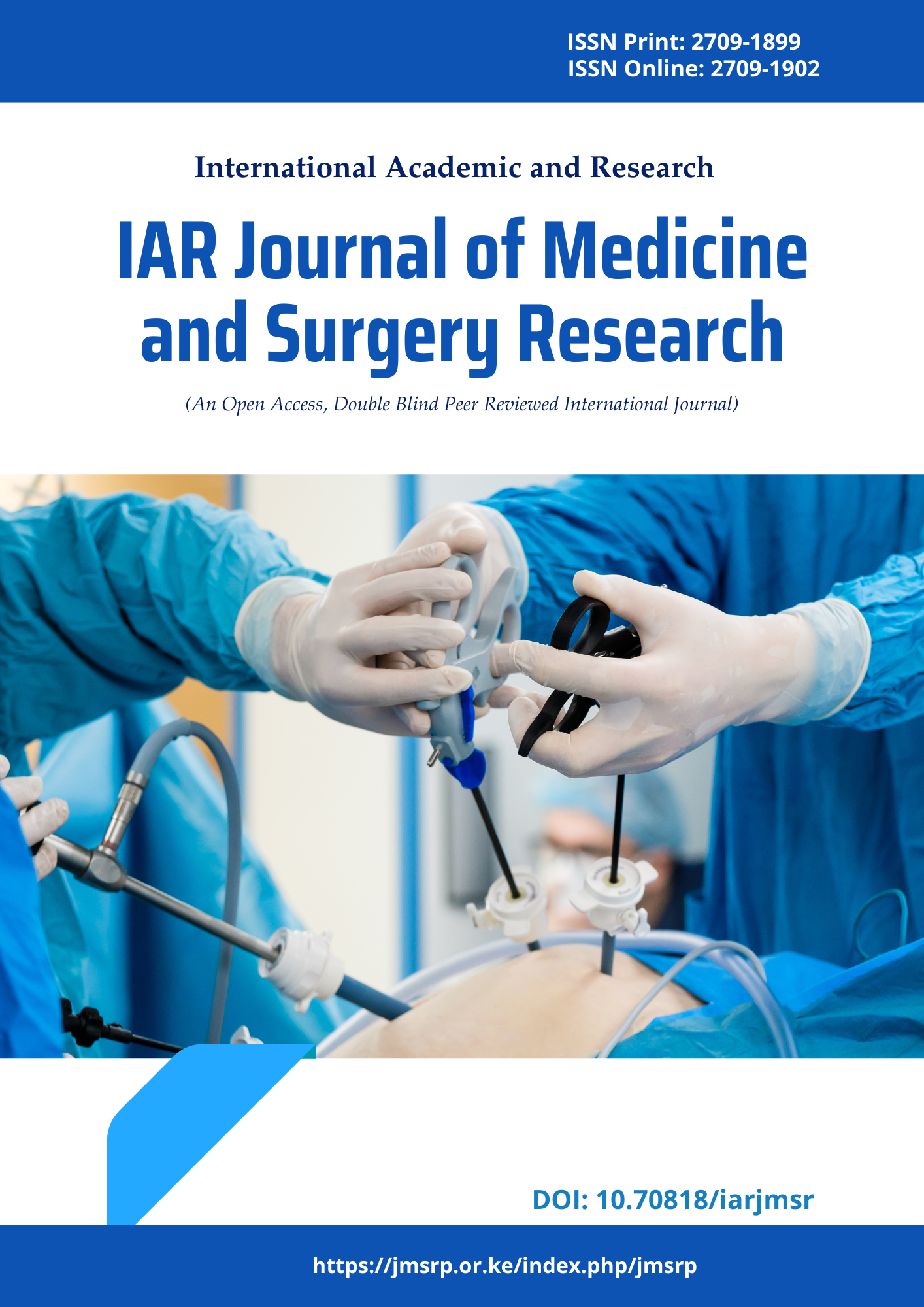
IAR Journal of Medicine and Surgery Research
2025, Volume:6, No 4 : 149-157 doi: https://doi.org/10.47310/iarjmsr.2025.v06i04.0184
Research Article
A Comparative Study of Open Onlay versus Retro-Rectus Sublay Mesh Repair for Ventral Incisional Hernia: One-Year Clinical and Surgical Outcomes
 ,
 ,
 ,
 ,
1
Junior Consultant, Department of Surgery, Upazila Health Complex, Mohanpur, Rajshahi
2
Assistant Professor, Department of Surgery, Rajshahi Medical College Hospital, Rajshahi
3
Assistant Professor, Department of Gynaecology and Obstetrics, 250 Bedded Hospital, Natore
4
Medical Officer, Upazila Family Planning Office, Kamarkhanda, Sirajganj
Received
Oct. 9, 2025
Revised
Nov. 22, 2025
Accepted
Nov. 15, 2025
Published
Dec. 31, 2025
Abstract

Background: Ventral incisional hernia repair remains surgically challenging, and optimal mesh placement technique is debated due to differences in operative complexity, postoperative morbidity, and recurrence outcomes. Objective: To compare oneyear clinical, surgical, and complication-related outcomes between open onlay and retro-rectus sublay mesh repair techniques for ventral incisional hernia. Methods: This quasi-experimental study was conducted at the Department of Surgery, Rajshahi Medical College Hospital, Bangladesh, from July 2022 to June 2024. Sixty patients were allocated equally to onlay (n=30) and sublay (n=30) mesh repair groups. Baseline demographics, operative parameters, postoperative complications, hospital stay, and recurrence were analyzed using appropriate statistical tests with significance set at p<0.05. Results: Baseline characteristics were comparablebetween groups (mean age: sublay 37.12 ± 7.04 vs onlay 39.52 ± 6.45 years; p>0.05). Mean operative time was significantly longer in the sublay group (127.4 ± 15.76 vs 115.71 ± 11.90 minutes; p=0.02). Sublay repair demonstrated shorter postoperative hospital stay (10.65 ± 5.12 vs 14.24 ± 5.07 days; p=0.02). Seroma (6.6% vs 43.3%), wound infection (6.6% vs 30.0%), mesh extraction (0% vs 10.0%), and sepsis (3.3% vs 13.3%) were significantly lower in the sublay group (p<0.05). Recurrence ratesremained low and comparable (6.6% vs 3.3%; p>0.05). Conclusion: Retro-rectus sublay mesh repair offers superior postoperative recovery and fewer wound-related complications despite longer operative time, supporting its preference for ventral incisional hernia repair

Keywords
License
Copyright (c) IAR Journal of Medicine and Surgery Research
Creative Commons Attribution License Creative Commons License
This work is licensed under a Creative Commons Attribution 4.0 International License.
All papers should be submitted electronically. All submitted manuscripts must be original work that is not under submission at another journal or under consideration for publication in another form, such as a monograph or chapter of a book. Authors of submitted papers are obligated not to submit their paper for publication elsewhere until an editorial decision is rendered on their submission. Further, authors of accepted papers are prohibited from publishing the results in other publications that appear before the paper is published in the Journal unless they receive approval for doing so from the Editor-In-Chief.
IARJMSR open access articles are licensed under a Creative Commons Attribution-ShareAlike 4.0 International License. This license lets the audience to give appropriate credit, provide a link to the license, and indicate if changes were made and if they remix, transform, or build upon the material, they must distribute contributions under the same license as the original.
Recommended Articles
Clinical Presentation and Endocrine Profile of Women Diagnosed with Polycystic Ovary Syndrome in a Tertiary Care Setting
22-28
PDF
Correlation between Thyroid Dysfunction and Glycemic Status in Type 2 Diabetic Patients
8-13
PDF
Bacteriological Study of Bile in Patients Undergoing Cholecystectomy for Chronic Calculous Cholecystitis
14-21
PDF
Relationship Neonatal Hyper Bilirubinaemia with TSH -An Observational Study
1-6
PDF
IAR Journal of Medicine and Surgery Research
+91-9707682512
+91-9707682512
support@jmsrp.or.ke
This work is licensed under a Creative Commons Attribution-NonCommercial-NoDerivatives (CC BY-NC-ND) license. Open Access Publication.

Copyright © International Academic Research Consortium. All rights reserved.
|
|
|